Examples Of Job Specialization . Work specialization, work specialization example work specialization is a term used to describe the extent to which work is divided. What does job specialization mean? 😂 What are some examples of job specialization. What is an example of from tukioka-clinic.com Job specialization can be found in almost every industry and at every level of employment. Must be an engineer and mba in marketing. Indeed, even the academic world plays a significant part in.
Specific Heat Capacity Examples. However, for the solids and liquids, the. The specific heat capacity of the gasses can be measured at the constant volume by enclosing the sample in the rigid container.
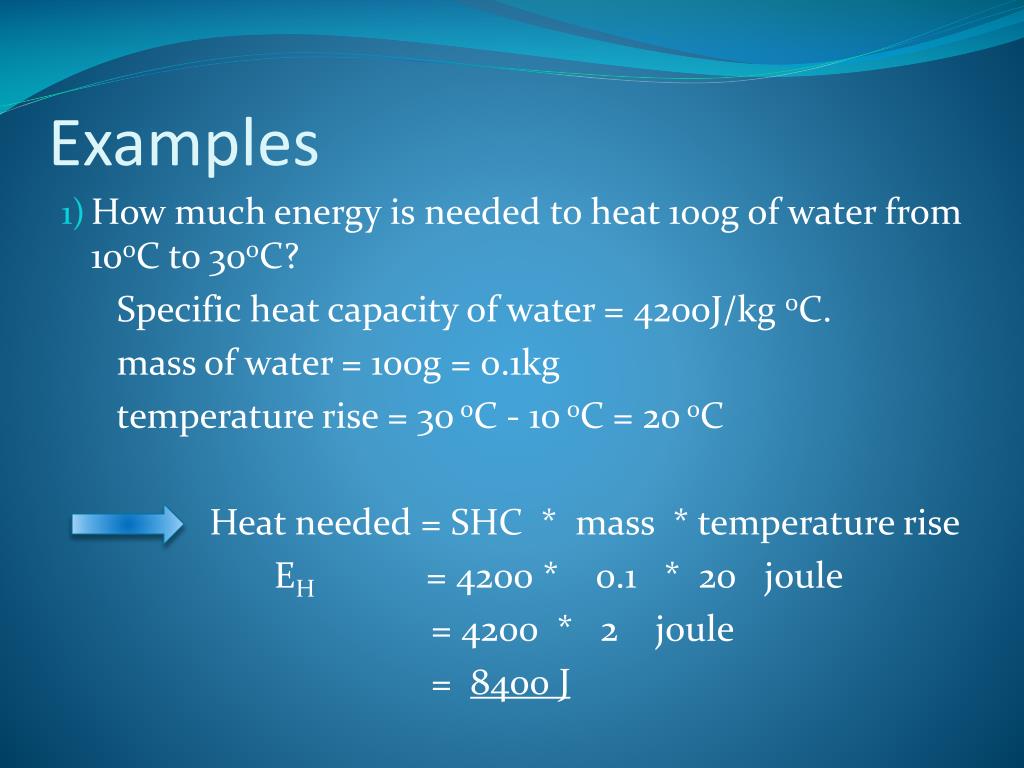
PPT SPECIFIC HEAT CAPACITY PowerPoint Presentation, free download from www.slideserve.com
In thermodynamics, the specific heat capacity (symbol cp) of a substance is the heat capacity of a sample of the substance divided by the mass of the sample, also. Specific heat capacity is the heat. Specific heat and heat capacity are related but different.
Specific Heat Capacity Is The Energy Required To Raise A Unit Mass Of A Substance By 1 K.
If it takes 10 calories to raise the temperature of a glass of water by 2 c, then the. Using specific heat capacity to find heat example: Specific heat capacity, also called specific heat or thermal capacity, is defined as the amount of heat needed to raise the temperature of a substance by 1 degree.
It Is Heat That Is Stored In An Item.
Specific heat and heat capacity are related but different. Specific heat capacity of water is approximately 4.2 j/g°c. Specific heat equation and definition.
In This Video, We'll Go Over Several Specific Heat Capacity Practice Problems And Examples.
It is used to measure the heat flow produced in a sample when it is either heated, cooled, or held. Ratio of the amount of energy absorbed to the associated temperature rise. The heat capacity of the substance is defined as the amount of heat required to raise the temperature of the substance by 1°c ;
Heat Capacity Is Also Known As Thermal Capacity And It Is Defined As The Amount Of Heat Required To Raise The Temperature Of A Given Mass Of The Substance By One.
Hence, the capacity of the heat of 120 grams is 18000.0 j. The formula of specific heat capacity: If i heat 10 objects made of ten different materials to the same temperature and set them out to cool.
Each Substance Has Their Own Specific Heat Capacity, Which.
55 rows the table of specific heat capacities gives the volumetric heat capacity as well as the specific heat capacity of some substances and engineering materials, and (when applicable). Now by using the formula of heat, we get, q = mc δt. If a 255 g block of copper sees its temperature decrease by 14.8{eq}^{\circ}c {/eq}, how much heat in.


Comments
Post a Comment